Artemis II is the first crewed lunar mission since the Apollo program more than 50 years ago. Four astronauts launched on April 1, 2026 at 22:35 UTC from Cape Canaveral, with the goal of flying around the Moon once. After several tests in Earth orbit, they fired their engines on April 2 at 23:49 UTC for the translunar injection (TLI) burn, which transitions the trajectory from an Earth orbit to a path around the Moon. Shortly afterwards, from 1:46 to 3:03 UTC on April 3, we were able to observe the Artemis II spacecraft Orion from Zimmerwald using our 80 cm telescope ZimMAIN.
This is far from routine and technically highly complex: Artemis was no longer in Earth orbit during this time, which meant that our standard procedures and calculations for satellite tracking could no longer be used. A workaround was therefore programmed and implemented within just a few hours beforehand. The telescope had to track at variable rates throughout the observation period, as Artemis was moving away from Earth. The apparent motion of Artemis across the sky more than halved over the course of the observations (from 9.5 arcseconds per second to 4.2 arcseconds per second), and the distance to Earth increased from 35,000 km to 53,000 km. Due to its trajectory, Artemis was only just above the horizon, which is generally not ideal due to atmospheric turbulence.
Our best 15-minute film sequence of the night shows Artemis centered in the frame while the background stars drift quickly past.
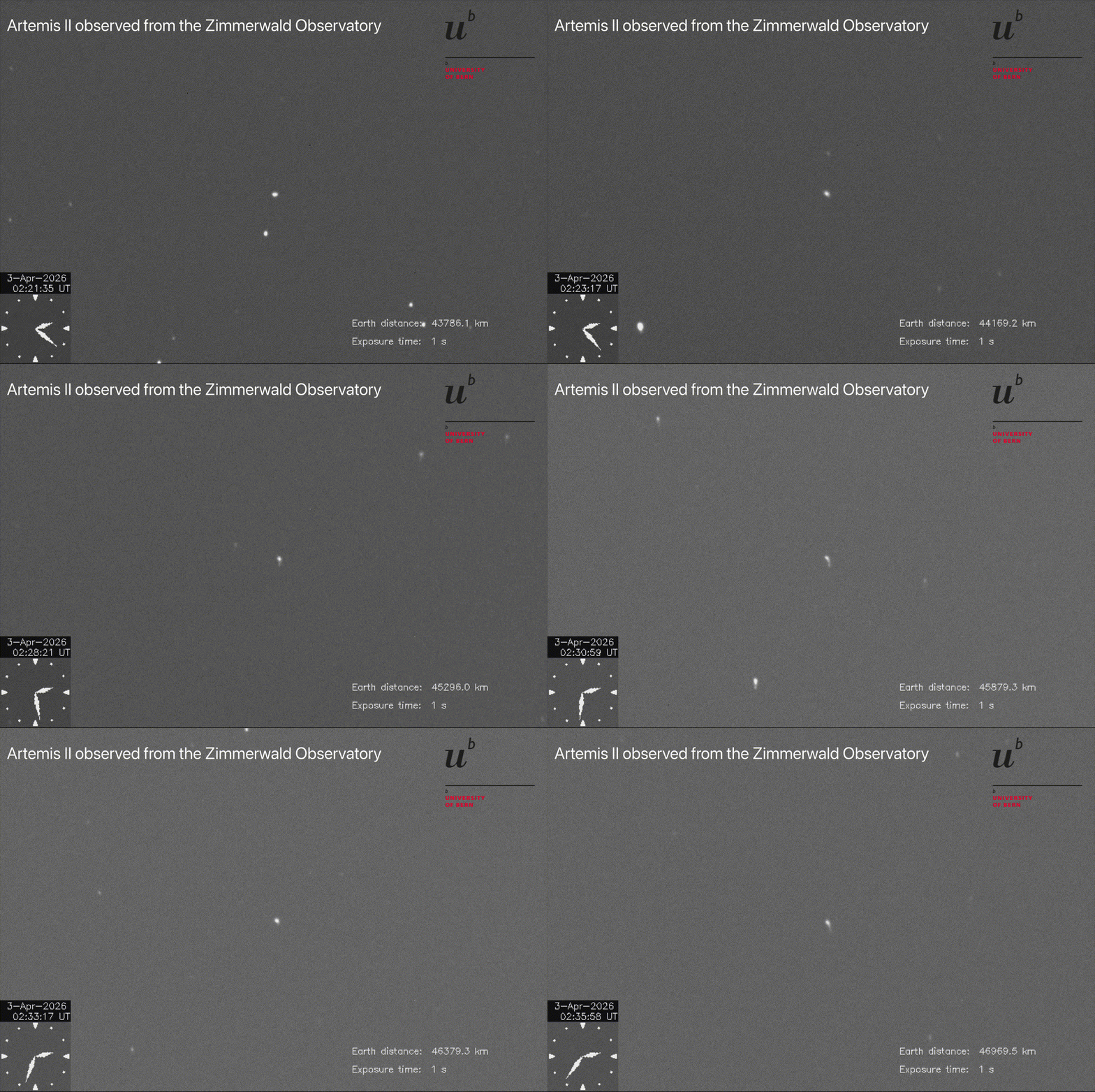
(Film copyright: AIUB. Data acquisition: M. Ackermann, data processing: L. Kleint)
The exact position of Artemis II in the sky (as seen from Zimmerwald) was calculated by us using so-called ephemerides from the Jet Propulsion Laboratory, from which we also produced the following plot. The top panel shows the elevation above the horizon in degrees, where negative values indicate that Artemis is below the horizon as seen from Switzerland. In principle, Artemis can be observed from Switzerland each day from around 2 or 3 a.m. onward, once the elevation exceeds approximately 10 degrees, though its brightness is continuously decreasing as it moves away from Earth.
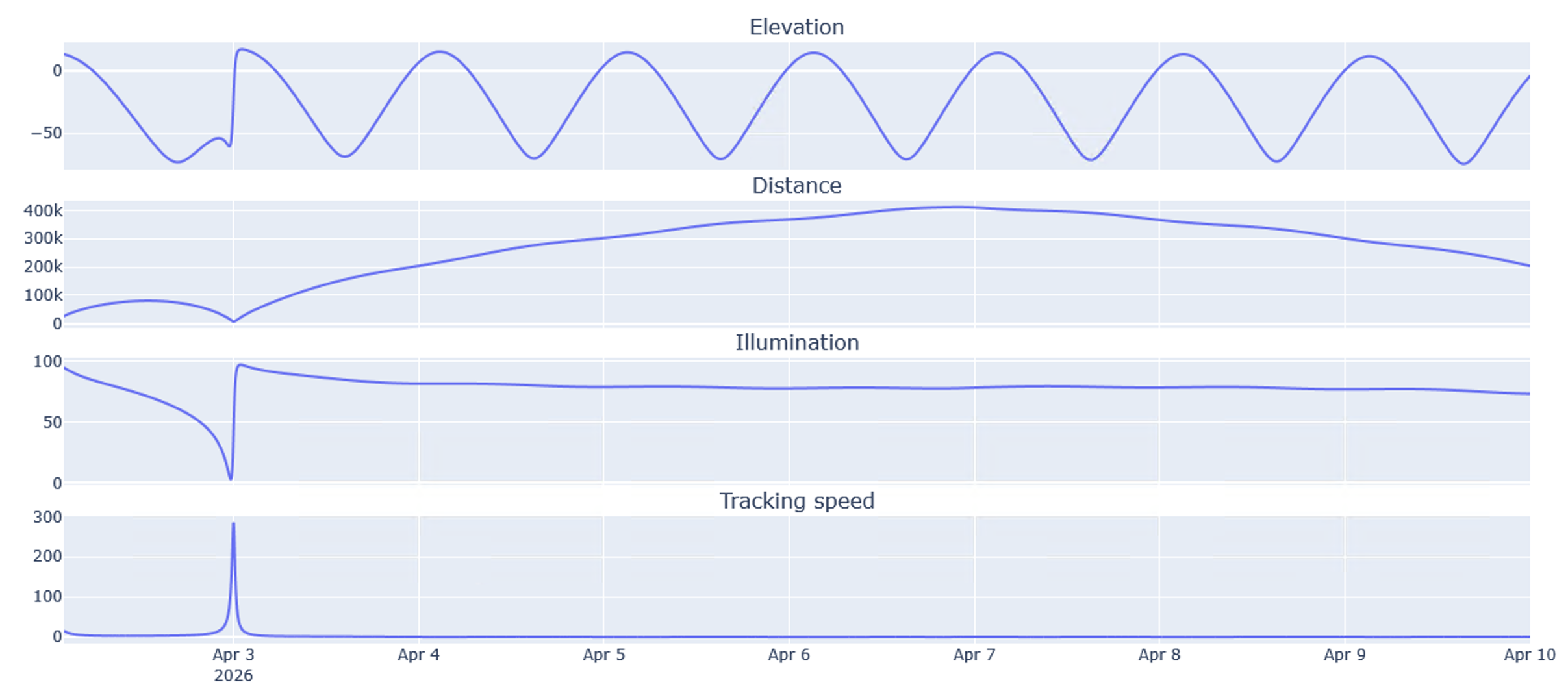
(Image copyright M. Ackermann). The second panel shows the distance from us to Artemis in kilometers, the third the illumination in percent, and the last the apparent motion across the sky in arcseconds per second.