Telescopes

AIUB operates 4 telescopes: ZIMLAT is a 1-meter telescope mainly used for geodetic laser observations. ZimMAIN is an 80 cm telescope used to capture images and spectra of various celestial objects. ZimTWIN consists of two 40 cm telescopes, primarily used for observing satellites in geostationary orbit and for student projects. ZimSMART is a 20 cm telescope used within the SMARTnet framework to observe satellites. The ZimNET dome was used before 2025 for the preparation and commissioning of various telescopes that are operated worldwide as part of the SMARTnet partnership with the DLR. In 2024, one telescope was shipped to Chile and put into operation. Since the end of 2025, a so-called DIMM telescope (Differential Image Motion Monitor) has been operating in the ZimNET dome, measuring atmospheric turbulence in Zimmerwald.

ZIMLAT (Zimmerwald Laser and Astrometry Telescope)
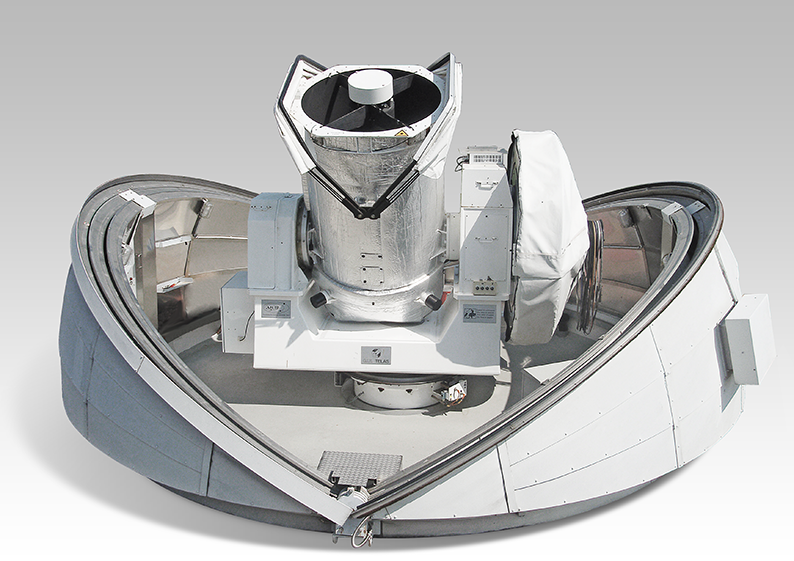

Illustration des Zimmerwald Laser und Astrometrie Teleskops

Technical Data

1m aperture
4 focal stations: f=1.2, 4, 8m
2k x 2k CCD
3k x 3k CCD
Coudé path for Laser
Fast mount: 30°/s, 20°/s2

General Requirements

The 1-meter Laser and Astrometry Telescope (ZIMLAT), which has been in operation since 1997, is primarily intended to enable modern satellite laser ranging (SLR). It can also be used as an astronomical telescope, to determine positions and brightness of near-Earth objects of all kinds using digital cameras (CCD).
This dual use of the system requires a high level of design complexity. Certain performance limitations, such as in image quality or observation density, must be accepted.

The telescope, its auxiliary equipment, as well as the additional components for laser ranging, can be remotely controlled via the station computer.

High positioning and tracking accuracy is required:

Absolute: 1–2 arcseconds, important for hitting the satellites during distance measurement with a tightly focused laser beam

Relative: A few tenths of an arcsecond, enables "smooth" tracking of slow-moving objects

During the day and twilight, the system operates exclusively in SLR mode. At night, the available observation time can be allocated to SLR and optical observations based on set priorities. Switching between operational modes is quick and computer-controlled (within half a minute).

Astronomical Telescope

  • High-precision tracking for
    • stationary objects (geostationary satellites)
    • slow objects (e.g., minor planets)
    • fast objects (low-flying satellites)
    • two tracking ranges
  • 0–1 arcminute/second with exposure times of several minutes
  • 0–1 degree/second with exposure times of a few tenths of a second
  • High image resolution: approximately 1" per CCD pixel
  • Field derotation according to various criteria
  • Fast switching between observation modes, i.e., multiple camera mounts with individual reduction optics

Satellite Laser Ranging (SLR)

  • Distance measurements to all satellites listed in the observation plan of the International Laser Ranging Service (ILRS) (at 300–25,000 km altitude)
  • Accuracy per single shot: a few millimeters to centimeters
  • Targeting accuracy and noise suppression also allow daytime observations
  • Fast switching between different satellites (10–20 seconds)
  • Remote control and monitoring (e.g., from the university)
  • Automated processes up to largely fully automatic operation
  • Dual-wavelength measurements, i.e., additional use of the primary (infrared) wavelength of the laser
  • 10 to 20 degrees minimum elevation
  • Visual tracking control at night with a wide-field camera

ZimMAIN

ZimMAIN is an 80 cm Ritchey-Chrétien telescope designed by ASA. It is used for night-time observations of various targets, such as planets, stars, and satellites. With a weight of ~850 kg, it requires a pillar through the building and into the ground for stability and avoidance of vibrations. By rotating the M3 mirror, the light can be sent to one of the exit ports where different instruments are mounted.

ZimTWIN

ZimTWIN consists of two parallel 40 cm telescopes. Its specialty is a wide field of view because of the comparably short focal length and a large camera chip. The twin setup allows us to either observe an object with two different filters for complementary spectral information, or to double the field of view by off-pointing one telescope. ZimTWIN can only be used with cameras and not visually.

ZimSMART (Zimmerwald Small Robotic Telescope)

Foto des Zimmerwald Small Robotic Telescope

Mainly used for Orbit maintenance (bright obj.) and object searches

Technical Data

0.2m aperture
f=0.5m
2k x 2k CCD
3k x 3k CCD
FOV 4.2°
Robotic

ZimNET (Zimmerwald Network Telescopes)

Astronomical seeing refers to the “twinkling” of stars in the night sky. It occurs because the air in our atmosphere is constantly moving and can have different temperatures. As a result, the way air bends (refracts) light changes slightly all the time. When light from stars or other celestial objects travels through this turbulent air on its way to Earth, it becomes slightly distorted. To us, this makes stars appear to twinkle. Telescopes are affected as well: instead of appearing as perfectly sharp points of light, stars often look like small blurry spots. Therefore, very detailed images can become blurred when the seeing is poor. Astronomers speak of good seeing when the air is calm and images are sharp, and of bad seeing when the air is very turbulent and images appear blurry.

To measure seeing, a special instrument called a Differential Image Motion Monitor (DIMM) is commonly used. A DIMM is a small telescope with a mask placed in front of its opening that contains two small holes. These two holes are separated by a fixed distance. The light from a single star passes through both holes and produces two separate star images on a camera. Because the atmosphere is constantly changing, the starlight is distorted differently along each path. As a result, the two star images “jitter” independently on the camera. The DIMM measures the difference in motion between these two images. From the strength of this difference, a known physical formula can be used to calculate how strongly the atmosphere is disturbing the light. The result is a numerical value for the seeing, indicating how calm or turbulent the air is at that moment. A DIMM telescope (ZimDIMM) has been operating in the ZimNET dome since the end of 2025.

Results

tbd

SMARTnet: A Telescope System to Survey the Geostationary Ring

SMARTnet is a worldwide network of telescopes. In a partnership with DLR, AIUB contributes to telescopes in Australia, South Africa and Chile. For more information, see Fiedler et al. 2023